

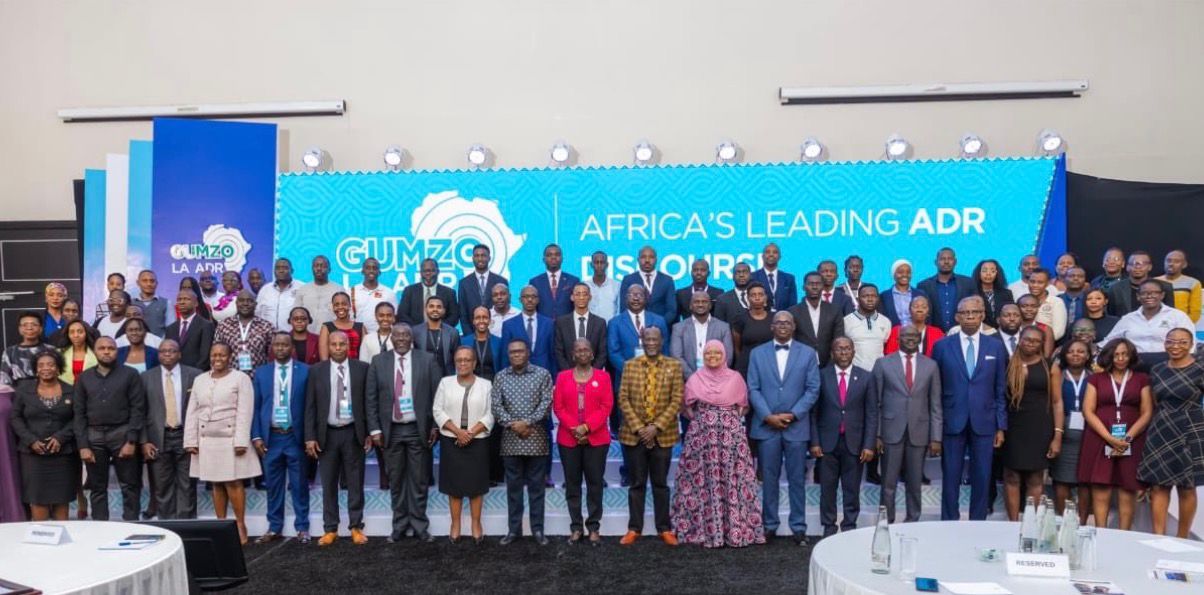
Jane Frances Abodo, the Principal Judge of Uganda, on Friday officially closed the five-day Gumzo La Alternative Dispute Resolution Conference at Mestil Hotel and Residences, bringing to a close a week-long engagement on the future of dispute resolution in Africa.
The conference attracted a diverse range of participants from the Judiciary, arbitration institutions, private legal practice, corporate legal departments and regional arbitration centres. Deputy Chief Justice Emeritus Steven Kavuma was also present.
In her closing remarks, Abodo thanked participants for their active engagement throughout the conference, describing the gathering as a transformative dialogue that had drawn together ideas from across Africa and beyond to reshape the future of justice.
“The conference had lived up to its name, Gumzo, meaning dialogue, by creating a platform for collaboration among judicial officers, practitioners, academics and policy actors to address the evolving justice needs of the continent,” she said.
Reflecting on the deliberations, Abodo noted that the conference had covered key areas including mediation, Alternative Justice Systems, construction dispute adjudication, domestic arbitration and international arbitration.
She said the discussions had underscored the growing importance of Alternative Dispute Resolution in reducing case backlog, promoting economic integration and delivering culturally responsive justice.
Abodo commended the Judicial Training Institute, the ADR Registry and the ALP Dispute Settlement Hub for the meticulous planning and coordination that ensured a successful conference blending policy dialogue with practical learning.
Citing a Karamajong proverb that says, “When people gather under a tree to solve a conflict, the conflict loses its strength,” she emphasised that dialogue remains at the heart of dispute resolution and reaffirmed that Alternative Dispute Resolution is the future of justice delivery in Africa.
Norbert Mao, President of the Democratic Party (Uganda) and Minister for Justice and Constitutional Affairs, welcomed the resolutions emerging from the conference and pledged the Ministry’s support in implementing them in collaboration with the Judiciary.
Mao announced that the Ministry would strengthen the Centre for Arbitration and Dispute Resolution, noting that recruitment processes would be concluded before the end of the month.
He also revealed that members of the National ADR Advisory Committee would soon be announced to guide policy implementation.
Mao emphasised that Alternative Dispute Resolution is deeply rooted in African traditions and should not be regarded as a foreign concept.
He observed that African justice systems have historically emphasised dispute avoidance, reconciliation, inclusiveness, consensus-building and matching disputes to the most appropriate resolution process.
He urged Africans to reclaim confidence in indigenous justice approaches, arguing that ADR should be understood not only as Alternative Dispute Resolution, but also as African Dispute Resolution and Appropriate Dispute Resolution.
Remarks on behalf of the Executive Director of the Judicial Training Institute were delivered by Lillian Bucyana, Acting Registrar in charge of the institute, who thanked participants and partners for their contribution to the success of the conference.
Bucyana said Alternative Dispute Resolution remains an indispensable component of modern justice systems because of its ability to promote efficiency, restore relationships and expand access to justice.
She reaffirmed the Judicial Training Institute’s commitment to strengthening training for judicial officers and justice sector actors, particularly in mediation, arbitration and Alternative Justice Systems.
She added that the institute would continue working with courts, mediators, academia and development partners to build the institutional capacity needed to effectively integrate Alternative Dispute Resolution into justice delivery.
